Aurora Flight Sciences and DARPA are continuing the assembly of the X-65 CRANE demonstrator, targeting a first flight by 2027.
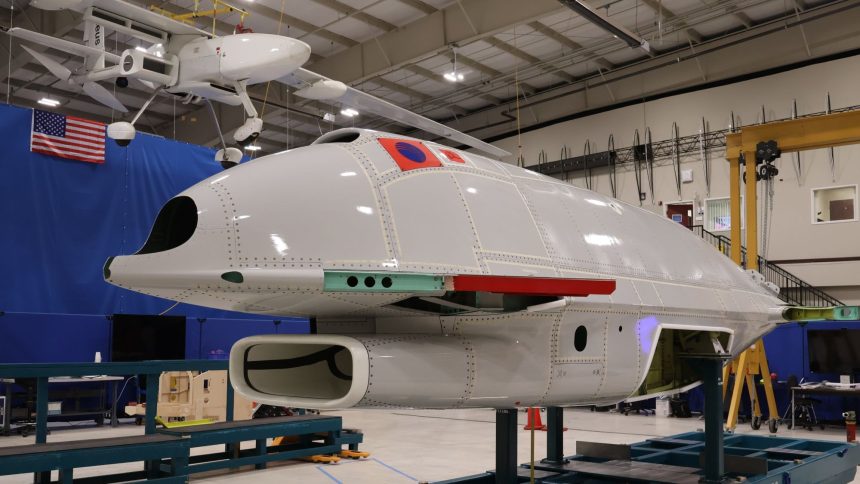
Aurora Flight Sciences’ (AFS) latest X-Plane, now designated the X-65, is taking its final shape. The company unveiled the fuselage of the unmanned demonstrator, which uses Active Flow Control (AFC) in place of conventional control surfaces, in two images in Feb. 24, 2026 and Apr. 2 on social media.
The aircraft is still missing the wings and the canted tails. The company said it is currently fusing the AFC-related components, systems and electronics into the fuselage, looking at a first flight in 2027.
Part of Defense Advanced Research Projects Agency’s (DARPA) Control of Revolutionary Aircraft with Novel Effectors (CRANE) program, in the works since 2020, the development program is now in its Phase 3. This stage involves flying a 7,000 pound demonstrator to validate the aeronautical concept, before AFC systems are incorporated into a full-sized aircraft.
https://platform.twitter.com/embed/Tweet.html?creatorScreenName=https%3A%2F%2Fx.com%2FParthSatam%3Ft%3DcoaKTN46G7ulZ_cH8tsoJQ%26s%3D09&dnt=false&embedId=twitter-widget-0&features=eyJ0ZndfdGltZWxpbmVfbGlzdCI6eyJidWNrZXQiOltdLCJ2ZXJzaW9uIjpudWxsfSwidGZ3X2ZvbGxvd2VyX2NvdW50X3N1bnNldCI6eyJidWNrZXQiOnRydWUsInZlcnNpb24iOm51bGx9LCJ0ZndfdHdlZXRfZWRpdF9iYWNrZW5kIjp7ImJ1Y2tldCI6Im9uIiwidmVyc2lvbiI6bnVsbH0sInRmd19yZWZzcmNfc2Vzc2lvbiI6eyJidWNrZXQiOiJvbiIsInZlcnNpb24iOm51bGx9LCJ0ZndfZm9zbnJfc29mdF9pbnRlcnZlbnRpb25zX2VuYWJsZWQiOnsiYnVja2V0Ijoib24iLCJ2ZXJzaW9uIjpudWxsfSwidGZ3X21peGVkX21lZGlhXzE1ODk3Ijp7ImJ1Y2tldCI6InRyZWF0bWVudCIsInZlcnNpb24iOm51bGx9LCJ0ZndfZXhwZXJpbWVudHNfY29va2llX2V4cGlyYXRpb24iOnsiYnVja2V0IjoxMjA5NjAwLCJ2ZXJzaW9uIjpudWxsfSwidGZ3X3Nob3dfYmlyZHdhdGNoX3Bpdm90c19lbmFibGVkIjp7ImJ1Y2tldCI6Im9uIiwidmVyc2lvbiI6bnVsbH0sInRmd19kdXBsaWNhdGVfc2NyaWJlc190b19zZXR0aW5ncyI6eyJidWNrZXQiOiJvbiIsInZlcnNpb24iOm51bGx9LCJ0ZndfdXNlX3Byb2ZpbGVfaW1hZ2Vfc2hhcGVfZW5hYmxlZCI6eyJidWNrZXQiOiJvbiIsInZlcnNpb24iOm51bGx9LCJ0ZndfdmlkZW9faGxzX2R5bmFtaWNfbWFuaWZlc3RzXzE1MDgyIjp7ImJ1Y2tldCI6InRydWVfYml0cmF0ZSIsInZlcnNpb24iOm51bGx9LCJ0ZndfbGVnYWN5X3RpbWVsaW5lX3N1bnNldCI6eyJidWNrZXQiOnRydWUsInZlcnNpb24iOm51bGx9LCJ0ZndfdHdlZXRfZWRpdF9mcm9udGVuZCI6eyJidWNrZXQiOiJvbiIsInZlcnNpb24iOm51bGx9fQ%3D%3D&frame=false&hideCard=false&hideThread=false&id=2039680357562265638&lang=en&origin=https%3A%2F%2Ftheaviationist.com%2F2026%2F04%2F03%2Fdarpas-x-65-demonstrator-taking-shape%2F&sessionId=ba37bd925c859f265ead39a1d277c214819df66f&siteScreenName=TheAviationist&theme=light&widgetsVersion=2615f7e52b7e0%3A1702314776716&width=550px
Traditionally, aircraft use control surfaces on the wings and the tail’s horizontal and vertical stabilizers, called ailerons, elevators and rudder, respectively. The CRANE program aims to eliminate them, with the Phase 1 of the program involving the testing of a small testbed with AFC systems in a wind tunnel.
The jets of air replacing the control surfaces as part of the new technology are expected to cut weight, improve aerodynamics and reduce mechanical complexity. Phase 2 saw both a Preliminary and then the Critical Design Reviews (CDR) of flight control software and control systems, which DARPA on Jan. 17, 2023 announced was completed, transitioning to subsequent Phases.
AFS had announced a contract award a month prior, on Dec. 12, 2022, saying it covered Phase 2 and the future Phase 3, the latter still optional at the time. DARPA explained AFS was chosen for its “innovations across aircraft configurations, autonomous systems, propulsion technologies, and manufacturing processes.”
Lockheed Martin and Georgia Tech Research Corporation were the participants in Phase 0, described as “a long conceptual design phase to give performers time to evaluate flow control options before solidifying their demonstration approaches.” DARPA has also selected AFS for another X-plane (experimental) project, the Speed and Runway Independent Technologies (SPRINT) program, with a rendering unveiled in October 2024 showing fan-in-wing (FIW) technology.
https://platform.twitter.com/embed/Tweet.html?creatorScreenName=https%3A%2F%2Fx.com%2FParthSatam%3Ft%3DcoaKTN46G7ulZ_cH8tsoJQ%26s%3D09&dnt=false&embedId=twitter-widget-1&features=eyJ0ZndfdGltZWxpbmVfbGlzdCI6eyJidWNrZXQiOltdLCJ2ZXJzaW9uIjpudWxsfSwidGZ3X2ZvbGxvd2VyX2NvdW50X3N1bnNldCI6eyJidWNrZXQiOnRydWUsInZlcnNpb24iOm51bGx9LCJ0ZndfdHdlZXRfZWRpdF9iYWNrZW5kIjp7ImJ1Y2tldCI6Im9uIiwidmVyc2lvbiI6bnVsbH0sInRmd19yZWZzcmNfc2Vzc2lvbiI6eyJidWNrZXQiOiJvbiIsInZlcnNpb24iOm51bGx9LCJ0ZndfZm9zbnJfc29mdF9pbnRlcnZlbnRpb25zX2VuYWJsZWQiOnsiYnVja2V0Ijoib24iLCJ2ZXJzaW9uIjpudWxsfSwidGZ3X21peGVkX21lZGlhXzE1ODk3Ijp7ImJ1Y2tldCI6InRyZWF0bWVudCIsInZlcnNpb24iOm51bGx9LCJ0ZndfZXhwZXJpbWVudHNfY29va2llX2V4cGlyYXRpb24iOnsiYnVja2V0IjoxMjA5NjAwLCJ2ZXJzaW9uIjpudWxsfSwidGZ3X3Nob3dfYmlyZHdhdGNoX3Bpdm90c19lbmFibGVkIjp7ImJ1Y2tldCI6Im9uIiwidmVyc2lvbiI6bnVsbH0sInRmd19kdXBsaWNhdGVfc2NyaWJlc190b19zZXR0aW5ncyI6eyJidWNrZXQiOiJvbiIsInZlcnNpb24iOm51bGx9LCJ0ZndfdXNlX3Byb2ZpbGVfaW1hZ2Vfc2hhcGVfZW5hYmxlZCI6eyJidWNrZXQiOiJvbiIsInZlcnNpb24iOm51bGx9LCJ0ZndfdmlkZW9faGxzX2R5bmFtaWNfbWFuaWZlc3RzXzE1MDgyIjp7ImJ1Y2tldCI6InRydWVfYml0cmF0ZSIsInZlcnNpb24iOm51bGx9LCJ0ZndfbGVnYWN5X3RpbWVsaW5lX3N1bnNldCI6eyJidWNrZXQiOnRydWUsInZlcnNpb24iOm51bGx9LCJ0ZndfdHdlZXRfZWRpdF9mcm9udGVuZCI6eyJidWNrZXQiOiJvbiIsInZlcnNpb24iOm51bGx9fQ%3D%3D&frame=false&hideCard=false&hideThread=false&id=2026294335898038505&lang=en&origin=https%3A%2F%2Ftheaviationist.com%2F2026%2F04%2F03%2Fdarpas-x-65-demonstrator-taking-shape%2F&sessionId=ba37bd925c859f265ead39a1d277c214819df66f&siteScreenName=TheAviationist&theme=light&widgetsVersion=2615f7e52b7e0%3A1702314776716&width=550px
X-65 fuselage revealed
The image released on Feb. 24, 2026 showed a direct frontal shot of the 7,000 pound demonstrator’s fuselage, with a large ventral air intake and a missing panel on the nose showing a serpentine duct leading to the engine. A clearer image of the fuselage was offered on Apr. 2, with a side-view showing the wings’ roots and a missing panel to allow setting the aircraft on a jig where the main landing gear would be located.
AFS said this fuselage was completed in mid-January at its facility in West Virginia. This completed fuselage was then delivered to another AFS facility in Virginia.
Both images clearly show the fuselage is empty, with the company explaining it will now be integrated with the AFC-specific electrical and propulsion systems, “while wing and tail manufacturing is advancing in West Virginia.” The February image of the fuselage’s front view also showed three holes on the chine line, which may be ports for the three air data probes (pitot tubes) seen across all renderings so far.